Sweet Sixteen victim-selection rule
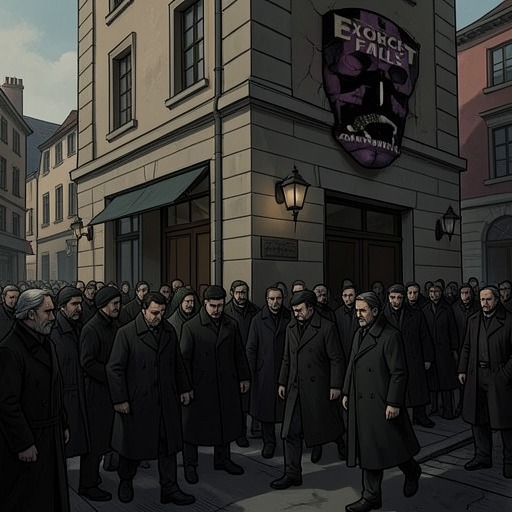
Exorcist FallsThe Sweet Sixteen victim-selection rule identifies the pattern that gives the Sweet Sixteen Killer its name: the victims are girls, with Makayla Howell explicitly described as sixteen. It makes the murders legible as a series, but not simple. Makayla’s killing marks an escalation in brutality, while Julia Deveroux’s death raises doubts about whether every murder attributed to the killer belongs to the same pattern. The rule therefore functions both as a clue about victim selection and as a fragile label imposed on crimes whose perpetrators and connections are not immediately clear.
The Pattern and Its Victims
The city learns of the seventh murder when the Sweet Sixteen Killer returns after a period of silence. Makayla Howell, a Black girl and a high-school student, is identified as sixteen. Her age makes the name of the killer seem literal, while the count of seven establishes that the violence has already formed a sustained series. The pattern’s force comes from the combination of age and gender: the victims are not presented merely as a succession of crime scenes, but as girls whose ordinary futures have been violently cut off.
The account of Makayla’s life resists reducing her to a statistic. She had been a model student until her sophomore year, when she began defying her parents and dating older boys. One of those boys got her drunk and tried to take advantage of her. When she refused him, he kicked her out of his apartment and made her walk home. Someone offered her a ride; she accepted, for reasons the police and her heartbroken parents could not explain. The killer drove her to a secluded park. These circumstances describe a chain of vulnerability and violence, but the text does not identify the person who offered the ride at that point in the account.
The selection pattern is thus set against the individual circumstances of a victim’s life. Makayla’s age connects her to the killer’s defining category, but her story also makes clear that the category cannot account for the particular sequence that brought her into danger. Her refusal of the older boy does not protect her from further violence; instead, she is forced onto the road alone and then accepts a ride from an unknown person. The narrative keeps her decisions and the failures surrounding them visible without treating them as an explanation for the crime.
Escalation and the Meaning of the Name
Makayla’s murder is described as the seventh and most sadistic atrocity yet. She was still alive when the killer began cutting her, and the attack is compared to the worst crimes of Jack the Ripper. After she died from her wounds, the killer raped her. This escalation changes the meaning of the recurring victim profile: the pattern is not a neutral counting device, but the frame through which an increasingly horrific series is understood. The title points to whom the killer selects; it does not soften what happens to them.
The number of victims also shapes the public’s expectations. When Liz later reports that the Sweet Sixteen has struck again, the reported death toll has reached eight. She says the latest killing happened at about nine the previous evening. The report matters because the apparent regularity of a serial pattern encourages the expectation that one killer is responsible for each new victim. Yet the timing conflicts with Danny Hartman’s whereabouts: he was at a convenience store from eight to ten. The narrator initially tries to resolve the discrepancy by assuming the authorities have the time wrong, showing how strongly the established pattern can govern interpretation even when a concrete fact challenges it.
Julia Deveroux and the Limits of the Rule
The eighth victim is Julia Deveroux, a schoolgirl walking home from Saint Anthony’s after a late play rehearsal. Her parents expected her to make the short walk home from school. The evidence identifies her as the newest victim associated with the Sweet Sixteen killings, but does not state her age. Her inclusion in the apparent series should therefore not be taken as proof that every victim is explicitly confirmed to be sixteen.
The circumstances of Julia’s death also unsettle the assumption that the series has one unchanging method. A report bearing the headline that the Sweet Sixteen has struck again gives the death toll as eight, but the accompanying discussion notes that the murder’s method appears to have changed. People are already calling it a copycat crime. The narrator independently considers that explanation and concludes that a different killer may be responsible, since Danny could not have committed a murder at the reported time if he was at the store. The distinction between the killer’s name, the public label for the murders, and the identity of the person who killed a particular victim becomes crucial.
Julia’s photograph makes that distinction more painful. The narrator recognizes her as a face previously glimpsed among Danny’s thoughts: a girl laughing with friends, unaware of the danger around her. The recognition arrives after her death and provokes the possibility that it might have been prevented. Liz explains that she is investigating for Julia and for the seven earlier victims. The victims’ smiling photographs, associated with hoped-for careers, friends, and families, stand against the aftermath of the murders. The rule groups the girls into a series, but those images restore some of the individual futures that the series threatens to erase.
Perpetrators, Attribution, and Significance
The apparent unity of the Sweet Sixteen pattern is complicated by what the narrative eventually reveals about responsibility. Danny Hartman is identified as the killer who raped and tortured Makayla, and as the policeman who wore blue. But Julia’s killing is attributed to Tyler Raines, who disembowels her. The two deaths are connected by the public’s understanding of the serial-murder case, yet the perpetrators are not the same. The name and its victim rule can therefore describe an apparent series while obscuring distinct acts and agents within it.
A further detail links one victim to the family at the center of the story. Joy Smith, another Sweet Sixteen victim, lived twelve blocks from St. Matthew’s and sometimes attended services there with her aunt. She had known Casey Hartman, a connection that likely led to Danny’s interest in her. This detail suggests that the selection pattern can coexist with personal proximity; the evidence does not establish that age alone explains why each girl was chosen. It instead places a particular victim’s connection to Casey alongside the broader category.
The rule’s significance lies in this tension. It makes the case recognizable to the police, the press, and the city, while the reported copycat killing and the later identification of separate perpetrators expose the limits of that recognition. It also risks turning murdered girls into entries in a count. The accounts of Makayla, Julia, and Joy counter that reduction with particular circumstances: a walk home after school, a ride accepted in distress, a photograph that triggers belated recognition, and a connection to someone the killer knew. The pattern explains the name; it cannot, by itself, explain each victim or contain the full truth of each crime.